
Paisley Time: The story behind the 17-minute difference from GMT
As the clocks go back this weekend, buddies in Paisley could be forgiven for setting their alarms a little later than others if they decide to stay on ‘Paisley time’.
That’s because, technically speaking, the town should operate on a local solar time that is 17 minutes and 43 seconds behind Greenwich Mean Time (GMT) – giving rise to the notion of ‘Paisley time’.
The curious time difference is rooted in astronomy and can be traced back to the town’s Coats Observatory, Scotland’s oldest publicly accessible observatory and one of only three historic observatories still operational in Scotland today.
Before the industrial revolution, every area kept its own local solar time derived from a sundial. Noon occurred when the sun reached its highest point in the sky, meaning that time differed from place to place depending on longitude – and as Paisley’s longitude is 4.43o west of Greenwich there is a time difference between the two locations.
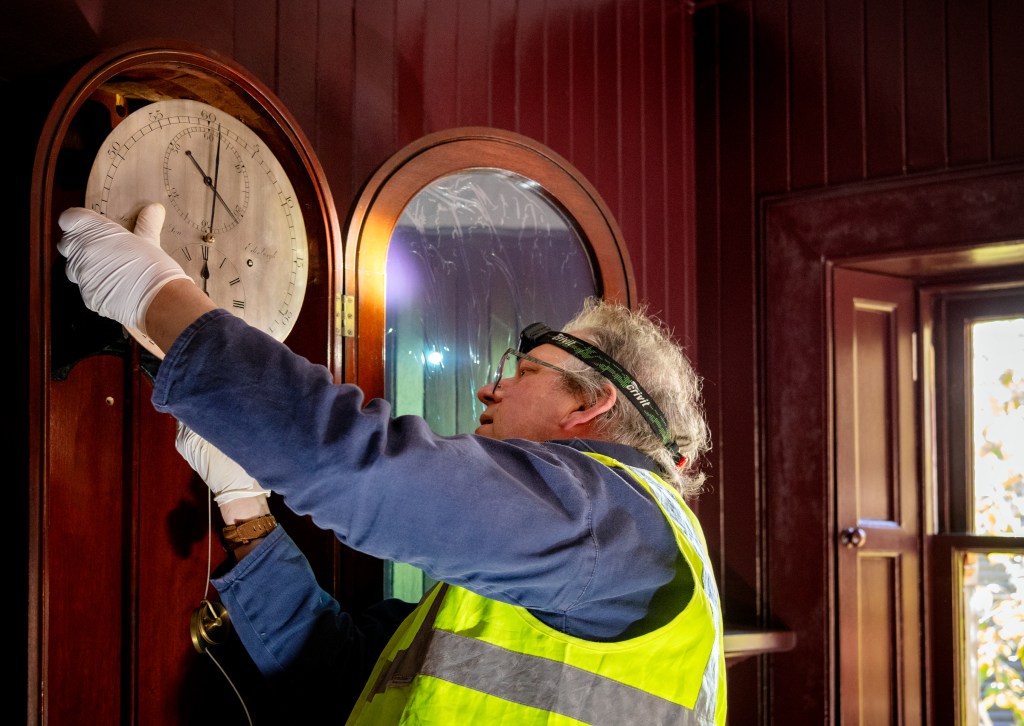
As part of the creation of Coats Observatory, businessman Thomas Coats also purchased a transit telescope along with three precision clocks: two sidereal clocks and a mean-time clock. These instruments required the construction of a separate building next to the observatory tower known as Transit House where staff were responsible for recording and monitoring time for the town. It was the time heartbeat of the town and will be part of the transformed Paisley Museum campus when it reopens to the public early next year.
Transit House takes its name from the process of measuring the precise moment a star crosses, or ‘transits’, the meridian line. The telescope inside was permanently aligned with that line, and when for example a clock star like Betelgeuse in the constellation Orion crossed the meridian, the sidereal clock was set to match the star’s coordinate time allowing astronomers to make exceptionally accurate measurements of time.
‘Sidereal’ or ‘star time’ is a time-keeping system based on the rotation of the Earth and the fixed positions of distant stars and this could be converted to Greenwich Mean Time, which made the observations from Transit House an extremely accurate way of measuring time and setting clocks for everyday use.
John Pressly, Curator of Science at Paisley Museum, said: “The inclusion of Transit House to Coats Observatory shows the scientific ambitions that Thomas Coats and the Paisley Philosophical Institution had for the town. The sidereal clock enables the telescope to be set up to view the wonders of the night sky using just their co-ordinates, meaning very distant objects not visible to the eye could be located and viewed at leisure. It also meant that the position of any astronomical discoveries could be recorded to allow other observatories across the globe to verify and study this new object.”
From 1840, the advent of the railways saw a need to create a standardised time zone across the whole of the country so ‘Railway Time’ was introduced which created a uniform time zone across the UK based on the time in Greenwich – and is why we call it Greenwich Mean Time (GMT).
Paisley made the decision to transmit GMT from Coats Observatory to public clocks around the town, including the Town Hall clock in late 1884, a clock in the Liberal Club in 1887 and in the early 1900s, the clock in the counting house at Ferguslie Thread Works and the gatehouse in Anchor Mill.
A signal was sent every 30 minutes from the ‘main’ clock to the ‘secondary’ clocks, in this case from the GMT clock in Transit House which ensured that their pendulums were keeping the same rhythm as the Transit House clock and keeping accurate time.
So, while the rest of the country follows GMT, Paisley can legitimately claim its own local time zone – making being on ‘Paisley time’ a real thing for local people.
Transit House is part of the Paisley Museum campus which has been transformed using an ambitious, striking design by international architects AL_A and brought to life by Kier to create a visitor attraction that will place Paisley firmly among the UK and Europe’s leading museum destinations.
The redevelopment by Renfrewshire Council in collaboration with OneRen is set to attract more than 127,000 visitors to the town each year to see the museum’s internationally significant collections, award-winning architecture and co-produced stories which will create a unique visitor experience.
The reopening of the museum in early 2027 will be the culmination of a decade of investment by Renfrewshire Council in Paisley’s cultural buildings, its cultural groups and performers, and its festivals and events. It has changed perceptions of the town, given people new reasons to visit, and contributed to it currently being Scotland’s Town of the Year.
The museum project has been funded by Renfrewshire Council, with additional funding from the National Lottery Heritage Fund, Historic Environment Scotland, and the Scottish Government, as well as private fundraising.
For more information on Paisley Museum and its transformation, visit www.paisleymuseum.org.




Leave a Reply