
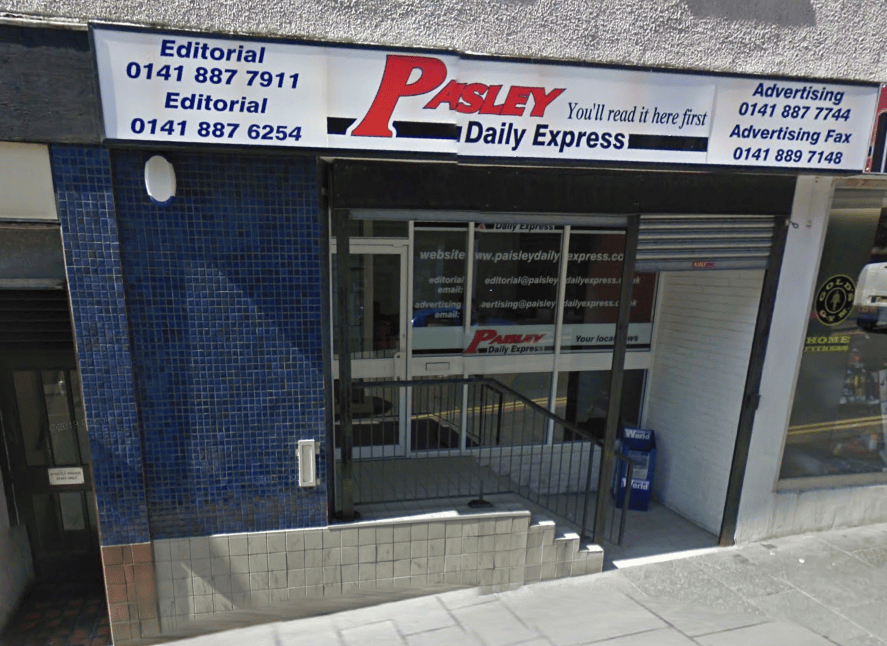
For generations, the Paisley Daily Express has been a familiar part of life in Paisley.
Affectionately known locally as the “Wee Express,” the newspaper was founded on September 1, 1874, by Largs-born publisher William A. Lochhead, at a time when Paisley was a rapidly expanding industrial town.
Its first office was at 15 Causeyside Street, with the newspaper quickly establishing itself as an important voice for the people of the town.
Lochhead’s vision went beyond simply reporting the news. He wanted the paper to champion local workers, the poor and the destitute, and he was involved in establishing the Association for the Relief of the Poor in Paisley.
The Express became deeply embedded in the community, reporting on municipal affairs, local organisations, community events and the booming textile and manufacturing industries that helped shape Paisley.
Over the years, the newspaper moved premises, relocating to 20 New Street in 1908 before later moving to 14 New Street.
But the newspaper landscape has changed dramatically.
In March 2012, editorial production was moved to Glasgow under its then-owner, Reach plc, although a small local presence was retained in Paisley.
Then came the digital age, with the publication launching the Renfrewshire Live app in August 2021, providing around-the-clock regional news through digital platforms.
Now, as the Express approaches its 152nd anniversary, questions are once again being raised about the future of local journalism.
The newspaper has recently risen to £2.80, a price which some readers say is becoming increasingly difficult to justify at a time when household budgets are already under pressure.
But perhaps more significant are concerns surrounding staffing.
The departure of the editor and sub-editor through early retirement has reportedly left the paper with just one journalist, alongside an editor with responsibility across a large number of local titles.
That inevitably raises a question for readers:
Can one small local newsroom continue to provide the depth of local coverage that Paisley deserves?
For many people, the value of a local newspaper has never simply been about filling pages.
It is about knowing the people, the streets, the organisations and the issues that matter to the community.
It is about covering the council meeting that nobody else attends, the community campaign that might otherwise go unnoticed, the local business opening its doors, the club celebrating an anniversary and the families and individuals who make up the fabric of Paisley.
There is also a concern that, with increasingly stretched resources, local papers could become more reliant on stories produced for sister publications and material that can be used across multiple titles.
If that happens, will readers still be getting a genuinely local Paisley newspaper, or simply a localised version of a much larger regional operation?
The Express has survived two world wars, huge changes in the newspaper industry, the decline of Paisley’s textile manufacturing base, the arrival of television, the internet and now social media.
Its history is unquestionably part of Paisley’s history.
But after 152 years, the Wee Express appears to be facing another important chapter.
Will Paisley continue to have a newspaper with the resources to properly cover Paisley — or will the traditional local newspaper become another casualty of the changing media landscape?
Only time will tell.




Leave a Reply